


Common sense dictates that human emotions are universal, biological, and evolutionarily hardwired. Under this classical paradigm, emotions are treated as localized, discrete entities. There are instinctive biological switches in the brain, such as “anger”, “fear”, or “sadness”, that are automatically triggered by specific environmental stimuli. In this view, human beings merely “have” emotions. The body acts as a passive container for affective reflexes, and these internal states are thought to be written plainly across the face, easily decoded by any perceiver across the globe without the mediation of language or cultural scaffolding. On this model, emotions arrive first; words merely label what is already there. Fear is fear. Joy is joy. The body knows.
The data, however, have not cooperated. Facial electromyography cannot reliably distinguish the muscle configurations of anger from those of sadness. Neuroimaging has failed to locate consistent, emotion-specific neural signatures. People frequently report emotional experiences without producing the facial movements predicted for those emotions and produce the predicted movements without reporting the corresponding inner state. What the body reliably signals, across cultures and conditions, are two broad dimensions: valence (pleasant or unpleasant) and arousal (activated or quiescent). But the
discrete categories, such as disgust vs. anger vs. fear, are not given by the biology. They are built on top of it.
If emotions were simply hardwired biological reflexes, a uniform physical stimulus would inevitably yield a uniform psychological and physiological output. Yet, any everyday scenario is inherently multifaceted and complex. The same situation can be interpreted as one in which your partner wronged you, in which case you are likely to feel an emotion like anger, or alternatively, as one in which you
did not earn your partner’s love, in which case you would feel an emotion like sadness or even shame. In this moment, you are not a biological machine mechanically registering a physical stimulus. Your mind is actively, selectively attending to specific cues, evaluating environmental data through a continuous process of meaning-making. Rather than passively "having emotions," you are actively "doing emotions" (Mesquita et al., 2017).
To understand how this active creation occurs, we must move beyond classic evolutionary theories and look toward constructionist frameworks. Crucially, constructionism is not a monolith; it operates across two distinct yet profoundly complementary dimensions: Psychological Constructionism and Social Constructionism. Together, they reveal that language acts as the ultimate conceptual glue, transforming raw physiological energy into internal psychological experiences, and transforming those internal experiences into meaningful social stances.
Act I: The Psychological Spine—Language as Cognitive Glue
To understand how we transition from “having” an ambiguous bodily sensation to “doing” a highly specific emotion, we must first establish the internal mechanics of the mind. This is the domain of Psychological Constructionism, championed by neuroscientists like Lisa Feldman Barrett.
The central claim of this view is that the brain does not receive a pre-labelled emotional signal and decode it. Instead, it receives a raw, continuous, undifferentiated stream of bodily sensation known as core affect. Core affect is the basic internal weather of the human organism, characterized simply by valence (pleasure or displeasure) and arousal (high or low metabolic energy). A racing heart, a tight chest, a sudden drop in stomach pressure, or a surge of adrenaline are not emotions, but raw, unparsed sensory data.
How does the brain transform an ambiguous physical state into a distinct, meaningful experience, such as anxiety, excitement, or the particular alertness of anticipation? It achieves this through a process of situated conceptualization, relying heavily on prior knowledge to categorize and respond to the immediate environment. When core affect surges, the brain treats it as an unparsed puzzle. It immediately looks backward, searching its vast library of past experiences to find a match that can explain why the body is reacting this way in this specific context (Barrett, 2006).
In this cognitive architecture, words function as the conceptual glue that holds otherwise highly variable perceptual instances together as members of a category. Without the word anger to bind them, the frown directed at a coworker, the clenched jaw during an unfair meeting, and the silent seething after an insult share too few regularities to cohere into a single recognisable experience. The word does not arrive after the emotion has formed, it participates in forming it. This is visible even neurologically: when participants are cued to perceive a neutral face as fearful, activity increases not only in language-related brain regions but in primary visual cortex, areas previously assumed to process only structural features of what the eye sees. The linguistic category changes how the brain represents the percept itself. Language and perception are not sequential; they are deeply entangled. In other words, if a highly specific emotion word is not actively available in your linguistic toolkit, your brain genuinely struggles to construct that state as a distinct, actionable feeling (Lindquist & Gendron, 2013).
The developmental evidence is equally striking. Children become able to perceive discrete emotions on faces precisely as they acquire the words for those emotions. Before learning the word anger, toddlers can distinguish pleasant from unpleasant faces but cannot differentiate a sad face from an angry one. Once the word is acquired, the perceptual boundary snaps into focus. Patients with semantic dementia who progressively lose access to the meaning of emotion words lose the ability to perceive discrete emotions correspondingly, reverting to sorting faces by valence alone. The categories, without their linguistic anchors, dissolve.
So far, so clarifying. But this account, though powerful, still treats the individual brain as the primary unit of analysis. It tells us that prior conceptual knowledge, carried in language, shapes how we parse and categorise our internal states. What it leaves open is the deeper question: where does that prior knowledge come from? Who decides which bodily states get a word, and which words get taught as emotions? To answer that, we need a second lens.
Act II: The Social Architecture of Feeling
Psychological constructionism establishes that emotions are built from raw bodily signal using conceptual tools acquired through experience. But those tools, namely the words, the categories, the distinctions a language treats as emotionally meaningful, do not emerge from a vacuum. They are handed down through the social and cultural systems into which every speaker is born.
Social constructionism situates this process within a broader architecture of relationships, cultural norms, and shared meaning-making. Its central claim, articulated by researchers including Batja Mesquita and Michael Boiger, is that emotions are not merely internal events that happen to occur in social contexts (Boiger & Mesquita, 2012). They are fundamentally relational acts, as ways of taking a stance toward the world, of establishing, maintaining, or disrupting connections with the people around us. As noted in the opening partner scenario, whether individuals construct anger or shame depends entirely on how they actively attend to and evaluate environmental and relational data. Emotions, on this view, are therefore best conceived as ongoing, dynamic and interactive processes that are socially constructed. This socialisation unfolds across three embedded contexts.
· Moment-to-moment interactions: At the most immediate level, emotions are shaped by the real-time relational exchange in which one person’s emotional behaviour is simultaneously a response to what has just happened and an invitation for what might happen next. Emotion here is not a private readout of an internal state; it is a move in an ongoing conversation.
· Developing and ongoing relationships: At the intermediate level, long-term relationships accumulate a shared emotional history, including patterns of appraisal, expectation, and permission, that become specific to particular pairs or groups of people. What it is acceptable to feel and express with a close friend differs from what is viable with a colleague or a parent, and those differences are negotiated and reinforced over time.
· Sociocultural contexts: At the broadest level, each society operates under a cultural mandate, which is a deeply internalized model of what it means to be a “good person”, how social life should be organized, and which emotions serve or threaten the collective. This mandate does not merely influence how emotions are expressed; it shapes which emotions get constructed as socially viable in the first place.
These mandates differ substantially across cultures, and their divergence has direct consequences for emotional life. In broadly individualist, Western contexts, the dominant mandate is independent: it prizes personal autonomy, self-expression, and the explicit verbalization of internal states. Emotions are understood as properties of the individual, authentic signals of a sovereign self that deserve expression and recognition. Naming one’s distress, frustration, or anger is not only acceptable but often treated as a mark of psychological health.
In broadly collectivist, East Asian contexts, the dominant mandate is interdependent: it prizes relational harmony, social cohesion, and the careful management of individual impulse in service of collective equilibrium. Here, emotional restraint is not repression, but it is maturity. The emotion one constructs and performs in a given moment is evaluated not only for what it says about the self, but for what it does to the web of relationships surrounding that self.
These are not merely stylistic differences in emotional expression. They are differences in the emotional categories that get built, the words that get taught as feelings, and the bodily states that get recognized as emotionally significant at all. The example that brought this home for me was deceptively simple. Three years ago, a social media post quietly disrupted the way I thought about my own mind. Someone had compiled a graphic listing hundreds of English emotion words, and a commenter had left a observation beneath it: “English speakers just seem to possess a much richer emotional landscape than us. They have so many more feelings”.
My reaction was immediate. This is not an emotional deficit, but a linguistic framing effect, a consequence of what each language teaches its speakers to recognize as a feeling at all. Consider the English word refreshed. When an English speaker steps out of a cold shower, they say, "I feel refreshed" and the word lands cleanly as an interior psychological state. Its closest Chinese equivalent, 焕然一新 (huàn rán yī xīn), is taught from primary school onward as a phrase for physical environments: a cleaned room, a renovated building. It describes wallpaper, not the human soul. Because the concept is never socially mapped onto interior experience in the Chinese context, it does not present itself as an emotional option when a Chinese speaker steps out of that same shower. The bodily state is identical. The cultural frame is absent. The emotion, in any linguistically legible sense, goes unconstructed.
This is the joint work of psychological and social constructionism, visible in a single word: the brain reaches for prior conceptual knowledge to parse bodily sensation, but that prior knowledge was itself assembled through years of socially and culturally specific experience that determined which distinctions were worth making and which sensations counted as feelings at all. We are not fewer in feelings. We are differently equipped with frames, frames built not by individual brains working in isolation, but by the collective social architectures within which those brains develop. Language is the glue. But culture is the mold that shapes what gets glued together.
Act III: The Experiment, and What It Revealed
Understanding this architecture intellectually is one thing. Discovering its contours through lived experience is another, and considerably less comfortable. When this realization hit me, I tried to optimize my way out of psychological confusion. I assumed that if my internal emotional landscape was a chaotic wilderness, I simply lacked the necessary vocabulary to tame it. The diagnosis seemed clear: I
don’t know what is wrong with me because I lack the words to name it.
To fix this, I sat down at my laptop and created a massive, grand emotional spreadsheet. I meticulously hunted down every complex emotion word I could find across English and Chinese, determined to build the ultimate linguistic map of human suffering and joy. The hypothesis was beautiful in its simplicity: if I gave my brain the definitive vocabulary list, the internal chaos would end. I would look at the spreadsheet, find the exact word for my current state of unease, and achieve instant clarity.
It was a spectacular failure. The list grew into hundreds of words, but the internal friction remained stubbornly intact. The words remained inert and they did not reach into the present and name what was happening now.
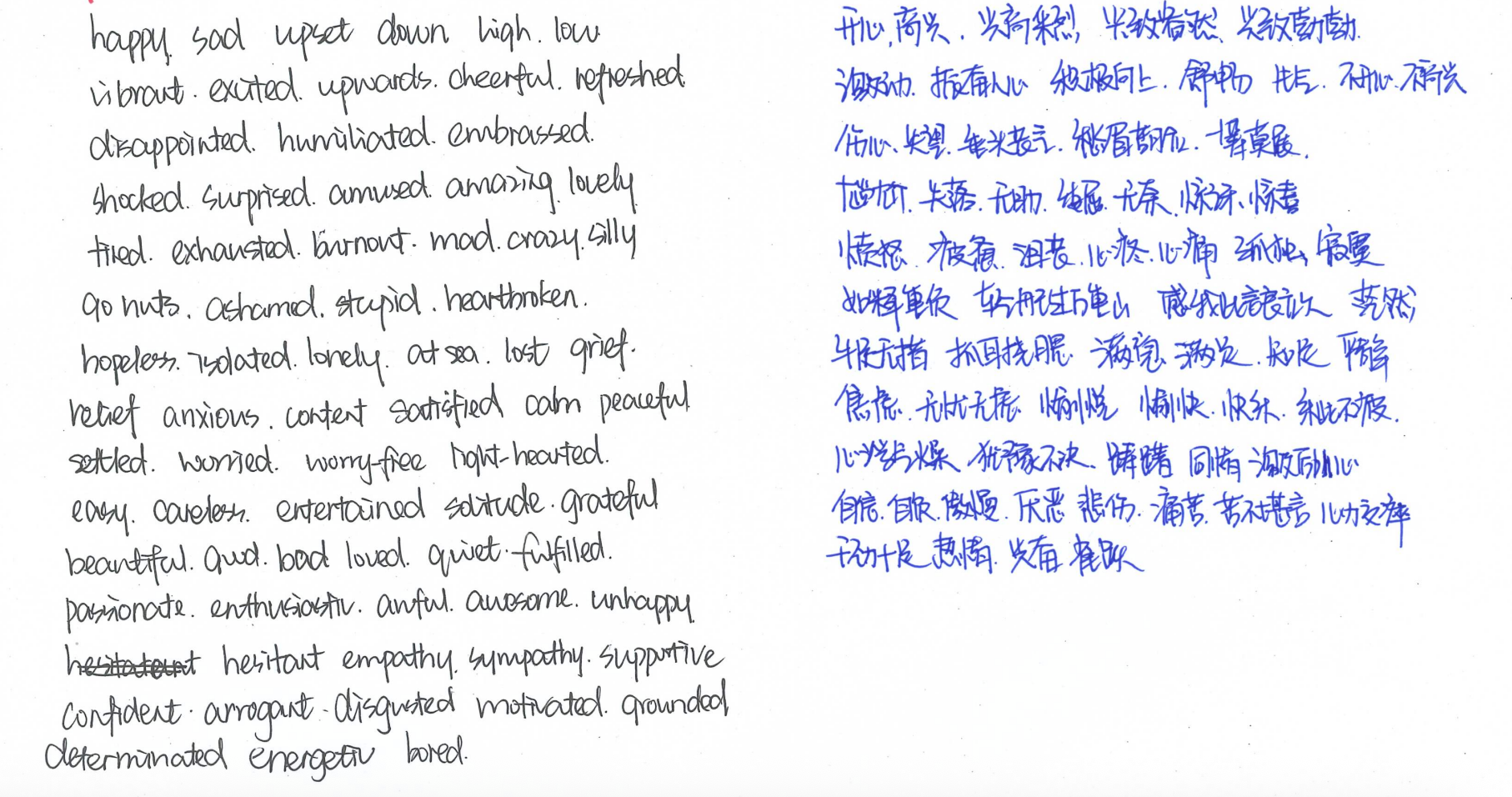
My experiment had collided with the distinction Barrett's research makes precise: the difference between passively knowing a word and actively possessing emotional granularity, which is a capacity to construct precise, differentiated emotional experiences tailored dynamically to the specific texture of a situation as it unfolds. Granularity is not a vocabulary size metric. It is a measure of how operatively grounded those words are in lived, embodied, situationally specific experience. For a word to function as genuine conceptual glue, it must be connected to a dense network of sensory memory, relational history, and repeated contextual use. That is to say, the brain cannot just look at an abstract dictionary; it must take the raw, buzzing, ambiguous bodily energy, namely, the core affect, and seamlessly fuse it with past experience and immediate situational context to create an emergent emotional product.
Act IV: The Bilingual Asymmetry
Having a dictionary doesn’t make you emotionally articulate any more than owning a blueprint makes you a master carpenter. And for those of us who live our lives across more than one language, this mapping process faces an even stranger asymmetry.
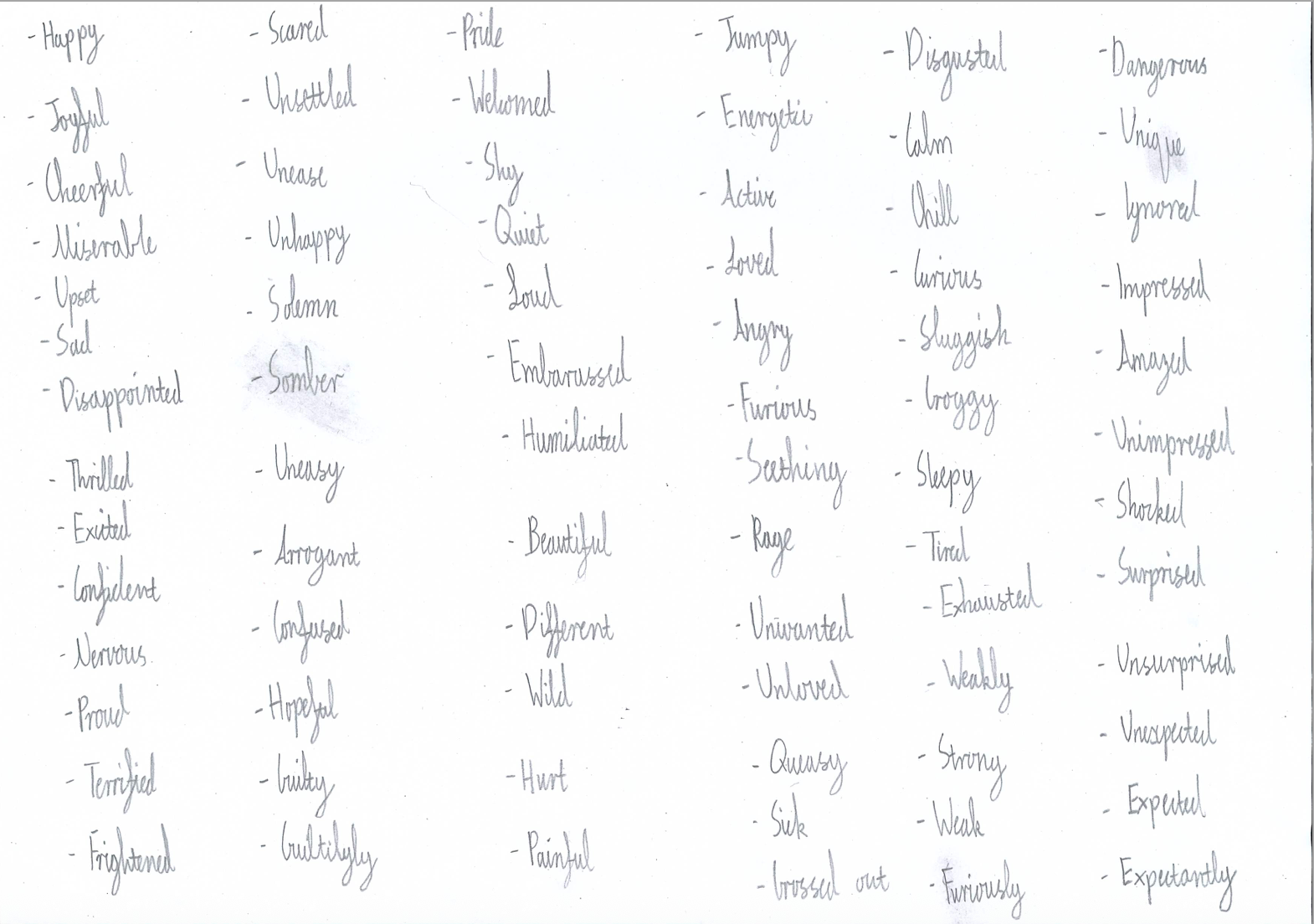
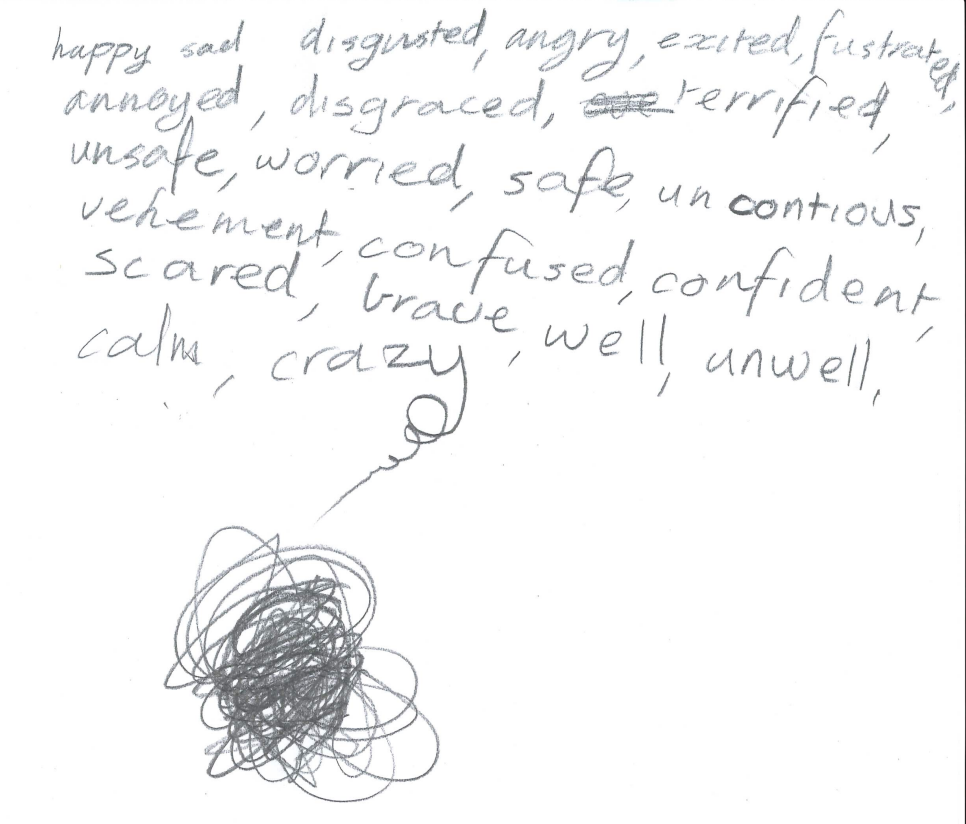
The experiment took a more illuminating turn when I brought in two children: a ten-year-old girl and her nine-year-old brother, raised in a household where English and Chinese were nominally both home languages. Their mother was the only Chinese-speaking presence in their daily lives, and English had quietly become the dominant register for school, friendships, and most of lived experience.
I asked them to write down emotion words in any language they chose. Both children reached immediately and exclusively for English. Neither child seemed to register Chinese as a natural emotional medium at all. The younger brother wrote a shorter list, but included advanced, intense words like vehement, which would never show up on my L2 list. The older sister’s list was populated with highly context-dependent words I wouldn't immediately consider as an emotion-related, like jumpy.
This is what cross-cultural psychologists call emotional acculturation, which is the gradual realignment of emotional experience towards the patterns of a dominant culture over time. Research on immigrant and bilingual populations has identified its key drivers precisely: (De Leersnyder et al., 2011; Zhou et al., 2021)
· The proportion and years of residence in the host culture correlate measurably with an incremental increase in emotional alignment with that culture.
· The age of arrival is critical; those who immigrate young carry less prior socialization from their origin culture’s emotional norms and acculturate more thoroughly.
· The density of one’s daily social network is the most powerful catalyst. The more one’s routine relationships are conducted in the host language, the more completely the emotional repertoire migrates.
For these two children, whose social world were almost entirely English-speaking, that migration was already effectively complete. Chinese remained a language of domestic warmth, but it seemed no longer a tool for emotional self-construction.
My own situation, however, was the structural inverse. As a Chinese-dominant L2 English speaker, I noticed that the English side of my spreadsheet was far less resonant, but infinitely more manageable. This is an asymmetry thoroughly studied in applied linguistics. Multilingual individuals using a foreign language (LX) frequently struggle to project the same nuanced, sophisticated, and confident selves they naturally inhabit in their first language (L1). This linguistic gap becomes painfully acute in intimate spheres. Studies show that many multilinguals who love a partner in an LX report that, particularly at the start of the relationship, lexical and conceptual limitations severely hamper their communication of emotion. Because the LX lacks deep emotional resonance, it generates a persistent feeling of inauthenticity. In this foreign register, emotion words feel strangely disembodied, swearwords lose their transgressive power, and expressions of love can feel tepid, clinical, and detached.
Applied linguists explain this through the Context of Learning Hypothesis. First-language emotion words are absorbed somatically, through years of intense, relational, embodied experience. The L1 arrives bundled with the physical shock of a childhood reprimand, the warmth of comfort, the acute social feedback of learning to be a person within a specific community. Laboratory measurements of skin conductance response (SCR) consistently show that L1 emotion words trigger automatic physiological reactions. The body registers them below the level of deliberate thought. A second language, acquired later in analytical or professional contexts, is processed differently: the semantic content lands, but the affective layer is thin. L2 emotion words convey information without generating heat.
Conclusion: The Dictionary We build ourselves
The four-part journey traced here, from the biology of raw affect, through the psychological tools that parse it, through the social architectures that shape those tools, to the cultural prohibitions that govern their use, reveals emotional life as something considerably more constructed, layered, and contingent than common sense suggests.
The biological substrate of human life is shared; but the construction of our emotions is not. By recognizing this, it means that the tools to construct emotions can be deliberately chosen. The emotional dictionary we never received is not waiting to be discovered. It is waiting to be built, one situation, one relationship, one carefully chosen word at a time.
So, what does that building actually look like, in practice?
Start with naming. My spreadsheet experiment failed not because vocabulary is useless, but because it was treated as a destination rather than a starting point. A word does not resolve an emotional state by being known in the abstract, it resolves it by being reached for, repeatedly, in the specific moments when the body is producing the feeling it names. Pause when something stirs internally and asking what is this, precisely? Name it, even imprecisely. The act of reaching for language is what develops the capacity to use it.
For multilingual speakers, the asymmetry between languages is not only a burden but a powerful resource. A foreign language that feels pale and clinical creates enough distance from the body’s automatic reactions to allow examination without overwhelm. When the emotional charge of an experience feels too heavy to approach directly, the L2 offers a way in, or a means of mapping the terrain safely before the full autonomic weight of the L1 is brought to bear. Think of it as the rubber gloves serving their actual purpose: protection during the initial handling of something that would otherwise be too hot to touch.
The native tongue, with all its cultural weight and relational prohibitions, is where the deeper work eventually happens. Recognise that the thick rubber gloves of a foreign language are a temporary protection, not a permanent home. A wound cannot fully heal in a language the body classifies as mere information. You must eventually bring those analytical insights back to your native tongue, allowing its deep somatic resonance to unlock true emotional release and catharsis.
True emotional fluency is not about memorizing a passive ledger of words. It is the dynamic, situated skill of knowing which linguistic tool to bring to a specific moment, turning a raw bodily signal into something precise enough to act on, honest enough to heal, and wise enough to live by.


