


Think about the last time you heard someone speak and instantly made a guess about where they grew up, how old they are, or what they do for a living. We all do it. For decades, traditional linguistics viewed these speech habits as a sort of passive reflex. If you were from a certain neighborhood or socio-economic background, your brain simply “outputted” the local dialect. You were a passive product of your demographics.
This foundational approach was famously demonstrated in the 1960s by linguist William Labov in his groundbreaking study of New York City department stores. Labov tracked how individuals pronounced the r sound in phrases like “fourth floor” across three different stores catering to distinct social class: high-end (Saks Fifth Avenue), mid-range (Macy's), and discount (S. Klein). He discovered a clear pattern: individuals at the luxury store used the prestigious rhotic r sound much more frequently than those at the discount store, directly associating rhoticity with a higher social class. Furthermore, Labov showed that when workers were asked to repeat themselves more carefully, their usage of the r sound increased across the board. In this classic view, style shifting was interpreted mechanically, a speaker simply paid more attention to their speech when a situation felt more formal or high-status.
While this early framework laid the groundwork for sociolinguistics, a powerful shift in modern language science, known as Third-Wave Variationist Sociolinguistics, expands this idea significantly. This modern perspective does not mean that demographics, socioeconomic class, and context are no longer important; they remain incredibly powerful factors that heavily condition how we speak. However, the third wave argues that beyond these baseline constraints, human agency emerges as a crucial, undeniable factor. Speakers are not just walking demographic statistics who talk a certain way because they cannot help it. Instead, we are all highly skilled, agentive actors. We take the baseline linguistic variations available to our social groups and use them, a vowel shifts here, a localized consonant sound there, as active building blocks for identity construction. We do not just speak a dialect to passively reflect where we belong; we strategically style our language to show who we are and how we want to be seen in the moment.
To understand how this works, we have to look at language as a dynamic toolkit rather than a rigid set of rules. Three core concepts define this new way of looking at speech:
1. Identity as a Performance
In older academic frameworks, identity was treated like a fixed passport stamp. The third-wave perspective argues that identity is an ongoing performance. It is a social reality that we continuously build, test, and adjust every time we open our mouths. You aren't just born with an identity; you construct it through your daily linguistic choices.
2. Human Agency
Agency is your power to make a conscious or semi-conscious choice. When you move between different social circles, you don't just passively mimic the people around you. You exercise agency. You might lean into a more formal way of speaking to project authority during a business presentation or intentionally adopt casual slang to signal solidarity and comfort at a backyard barbecue.
3. The "Indexical Field" (The Menu of Meanings)
In our minds, linguistic features do not have just one fixed meaning. Instead, they occupy what sociolinguists call an indexical field, a dynamic menu of linked traits, attitudes, and cultural stereotypes. When a speaker uses a specific accent feature, they are pointing to a cluster of potential meanings on that menu. The exact meaning only becomes clear when it is bundled together with other clues, like your clothes, your body language, and the topic of conversation.
From the Streets of Detroit: The Adolescent Trailblazers
The third-wave perspective grew out of extensive research within English-speaking communities; we can look to a classic study of American teenagers to see exactly how these dynamic toolkits function in everyday life.
In the late 1980s and 1990s, linguist Penelope Eckert conducted a long-term study of adolescents at Belten High, a suburban high school located on the rural-urban fringe of Detroit, Michigan. Traditional sociolinguistics would have predicted that these students all spoke similarly, given their shared geographic location and relatively uniform middle- to working-class backgrounds. Instead, Eckert discovered that the students had actively split themselves into two adversarial, self-constructed cultural groups, or "Communities of Practice": the Jocks and the Burnouts.
· The Jocks were corporate, school-centered, and college-bound. They fully accepted the school’s institutional authority and played by its rules.
· The Burnouts were urban-oriented, anti-institutional, and bound for the local workforce. They explicitly rejected high school culture, preferring the gritty, independent adult world of the nearby city of Detroit.
What made this social divide fascinating to linguists was the sound of their voices. At the time, a major regional pronunciation shift known as the Northern Cities Chain Shift was silently moving through the Great Lakes area, changing how vowels were pronounced (causing words like bus to sound like boss, or block to sound like black).
Eckert discovered that a teenager's demographic background, such as their parents' actual income, did not accurately predict how advanced their accent shift was. Instead, the pronunciation was an active, agentive choice. The Burnouts, looking to index a persona of gritty urban independence and rebellion, aggressively adopted the newest, most radical vowel changes. They bundled these language clues together with distinct material symbols: smoking in the school courtyard, wearing fringe jackets, and hanging out in urban Detroit spaces.
Crucially, the "Burnout girls" who wanted to project the absolute toughest, most uncompromising personae within their group used the most extreme forms of these vowel shifts. The sound change was not a robotic reflex of their social class; it was a consequence of adolescents exercising agency to map out their social terrain.
This iconic English example proves that even within a single school building, macro-demographics are only a starting point. The real linguistic action happens when individuals pull resources from the indexical field to take a stand, broadcast an alignment, and declare who they are to their peers.
From the Streets of Beijing: The Rhotacization Clue
There is another classic feature in Beijing Chinese: rhotacization (儿, or the er sound added to the ends of words).
In traditional linguistic studies, rhotacization was often mapped out mechanically. Researchers counted how often a speaker dropped their tongue back to make the er sound and tied it directly to broad demographic lines, noting it was generally more frequent among older, working-class, male residents born and raised in the heart of the city. From a third-wave perspective, however, rhotacization is much more than a passive geographical habit. It is an active semiotic tool used for personal branding. When a speaker heavily spices their Mandarin with rhotacization, they aren't just announcing their GPS coordinates. They are exercising agency to construct a specific, culturally resonant persona: the lǎo běijīng (老北京 - "Old Beijinger").
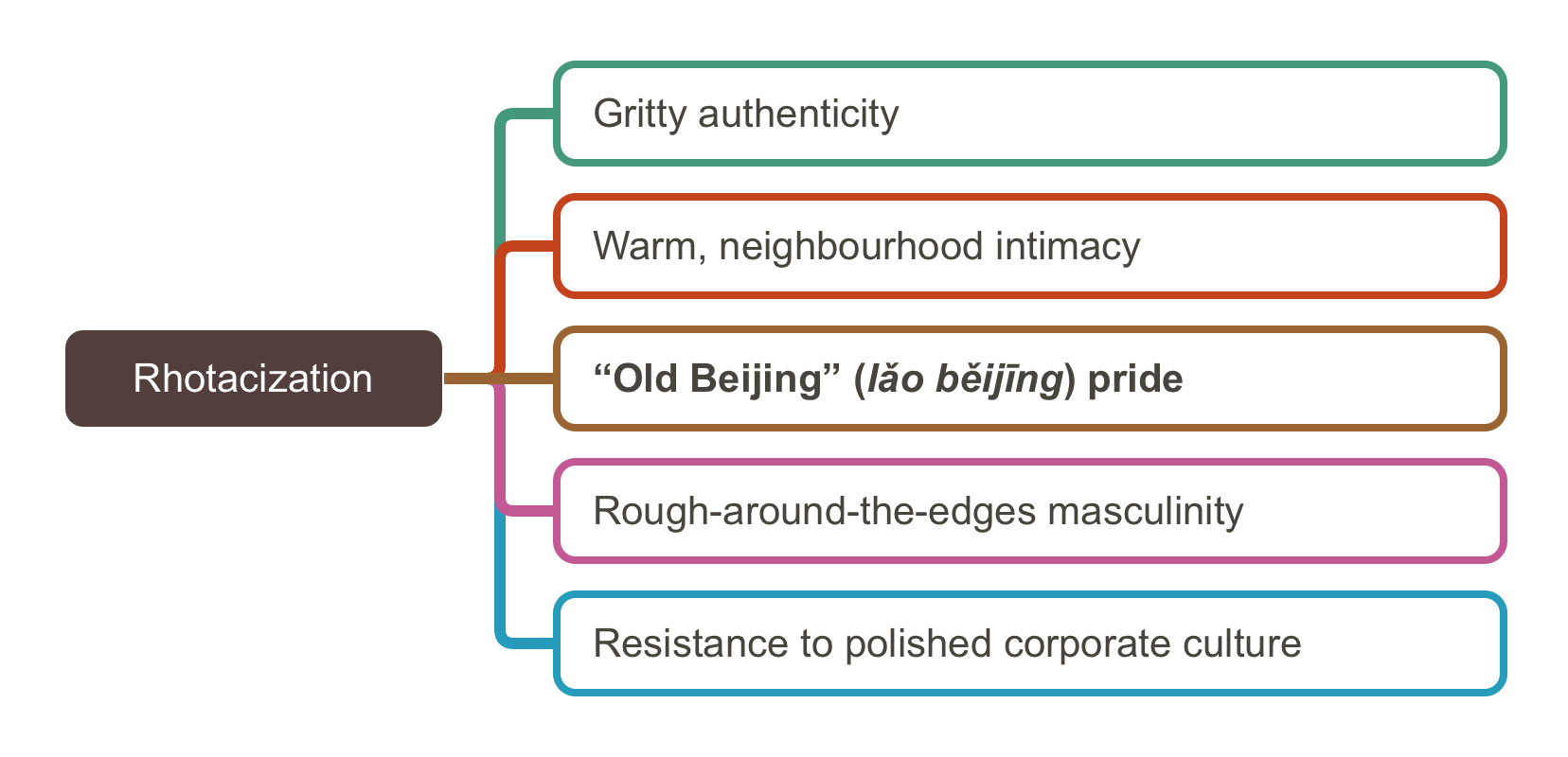
This persona carries a rich menu of social meanings—an indexical field. On one hand, it signals a fiercely proud local identity, gritty urban authenticity, and warm, neighbourhood intimacy. On the other hand, it stands in sharp, intentional contrast to the polished, neutralized, and somewhat sterile "Standard Mandarin" spoken in corporate boardrooms or by non-local migrants.
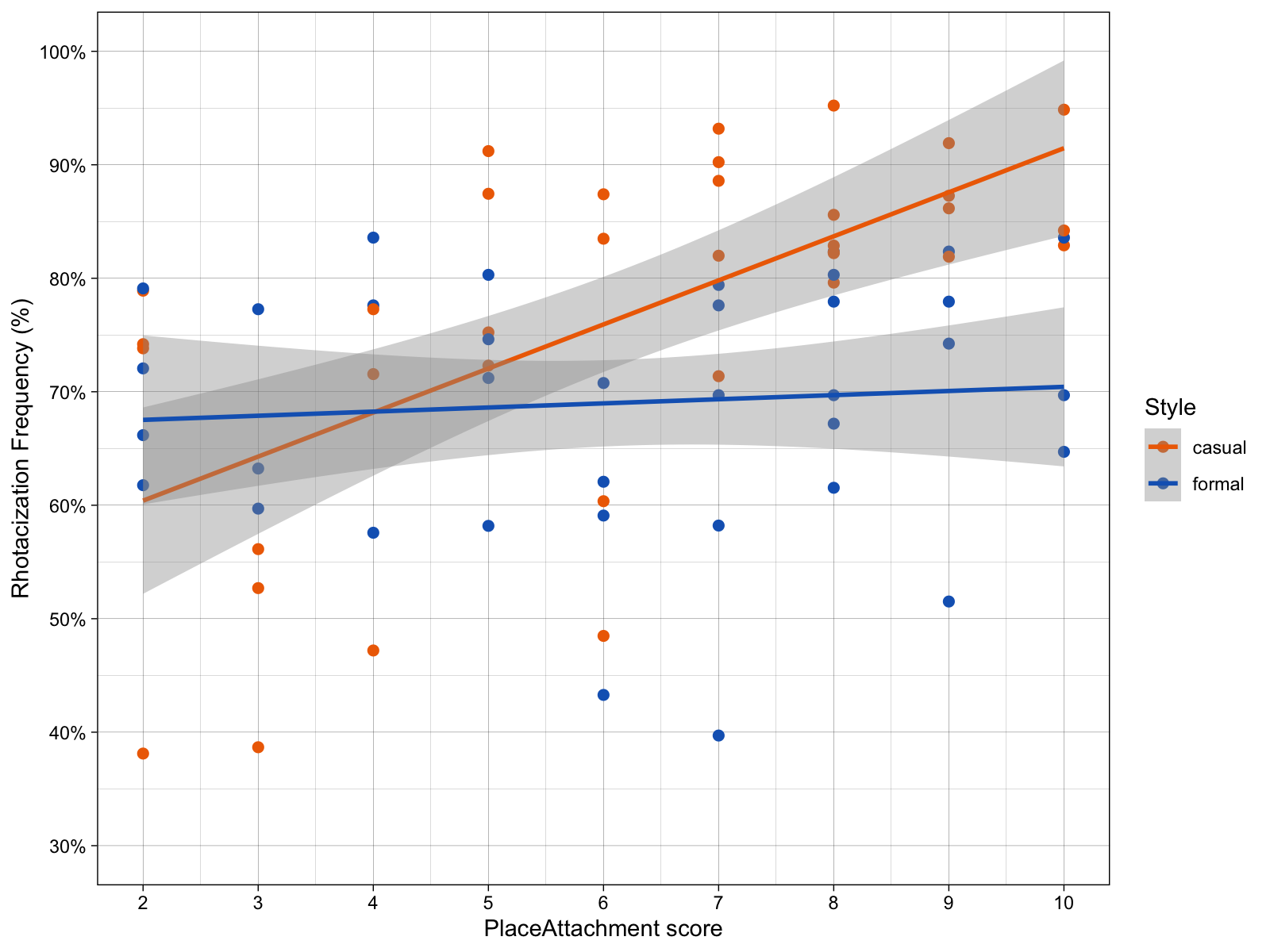
To measure how this identity work operates under real-world conditions, I designed a metric called a Place Attachment Score. This score quantifies an individual's objective and subjective "localness", their deep-rooted connection to their local neighborhood, their history within the city, and their active ties to the local Beijing community. When I map this psychological and social attachment against how often speakers actually use rhotacization, a fascinating picture of human agency emerges.
The Intersection of Style and Sentiment
The data shows that people do not use this local language clue blindly. Instead, their agency is strategically unleashed or held back depending on the immediate social style and context.
If we look at how speakers behave in a formal context (such as a structured reading task), a remarkable pattern occurs: a person’s Place Attachment Score is completely flat and statistically insignificant. Whether a speaker feels an intense emotional bond to local Beijing culture or holds a relatively detached view, they use rhotacization at a universally suppressed, stable baseline level. Why? Because the formal context triggers systemic societal expectations. In a professional or academic frame, the macro-forces of the standard "linguistic market" impose strict structural constraints, causing speakers to temporarily shelve their localized identity work in favor of standard norms.
However, the moment speakers drop their guard and shift into a casual context, the underlying power of agency is unlocked. In casual conversation, the statistical slope becomes incredibly clear and pronounced. As a speaker’s attachment and commitment to the local community increase, their frequency of rhotacization climbs sharply. This stark contrast between the flat, institutional baseline of formal speech and the climbing, expressive slope of casual speech provides beautiful empirical proof of the third wave in action. A high capacity for localness does not mechanically force a person to sound like a “Lao Beijing” 24/7. Instead, speakers utilize rhotacization as an intentional, stylistic resource. They dial it down when navigating formal constraints, but agentively weaponize it in casual settings to project authentic belonging, navigate local trust, and wear their local pride on their sleeve.
How We Blend Our Language: The Art of Bricolage
Speakers rarely rely on just one single trick like rhotacization to build a persona. Instead, we practice what sociologists call bricolage, the art of grabbing various pre-existing cultural resources and blending them together to create a unique personal style.
Think of it like an interior designer pulling a vintage rug, a modern lamp, and an industrial desk into a single room to create a “boho-chic” aesthetic. In language, our aesthetic is our social persona, and our furniture pieces are our linguistic clues:
· The Sound (Phonetics): How crisp are your consonants? Do you drawl your vowels? Do you drop the ends of your words?
· The Vocabulary (Lexicon): Do you use corporate jargon (“deliverables”, “synergy”), local slang, or academic vocabulary?
· The Structure (Grammar & Pragmatics): Do you speak in short, blunt sentences to project power, or do you soften your speech with hedging phrases (“I just think”, “maybe”, “sort of”) to appear approachable and polite?
When these elements are bundled together, they sharpen the image we project. A high school student who pairs standard grammar with specialized internet slang and a detached tone is building a very specific "effortlessly cool" persona. A politician who drops their regional accent during a policy debate but dials it up significantly when visiting a local factory is using the exact same mechanism to hunt for political authenticity.
The Tiny Choices: Human Agency in an Agentic AI Age
This shift in how we view language doesn’t just change how we see individual conversations; it fundamentally transforms our understand of human language itself unfolds. Languages don’t evolve in isolation through abstract, robotic, or purely systemic shifts. Language change is driven from the ground up by everyday people exercising active social agency. When a cool or influential group within a specific community starts using a new linguistic clue to project an attractive persona, other people notice. They copy it, blending it into their own style. Over time, that tiny interactional choice ripples outward, spreading from friend group to friend group, migrating across neighborhoods, and eventually reshaping an entire regional dialect. Every major shift in the way humanity speaks started as a small, creative choice by an individual trying to say something meaningful about who they were.
By moving our focus away from rigid demographic boxes and treating variation as a dynamic social system, the third-wave perspective honors the profoundly deliberate ways human beings use language clues to navigate their worlds. Identity is never a static template stamped onto an individual by their socio-economic origins. Instead, it is a continuously evolving, fragile tapestry woven from our moment-to-moment phonetic, lexical, and structural decisions.
In modern tech discourse, we constantly talk about “agentive AI” and automated systems designed to predict or mimic human behavior. But linguistic research proves a critical truth that it is human beings who possess the ultimate, non-programmable forms of agency. An algorithm can track broad linguistic statistics, but it cannot replicate the nuanced social calculation of a speaker navigating an immediate interaction. It cannot feel the emotional pull quantified by a Place Attachment Score, nor can it strategically decide to drop its guard in a casual conversation to unlock local trust, project a proud Lao Beijing persona, or subtly resist the sterile conformity of a corporate standard.
Through the hidden architecture of the indexical field and our local communities of practice, we do not just speak to exchange information. We speak to assert our humanity, negotiate our status, and declare our alignments. As we move further into a digitally mediated world where the boundaries of identity are constantly being blurred and contested, remembering the power of our own linguistic agency is more vital than ever.
Every time you choose a specific word, accent feature, or conversational style, you are not acting as a passive data point in a census. You are exercising the strongest force in language history: the distinct, beautifully messy, and fiercely agentive human voice.


